Science View

Research on Structure Optimization and Failure Mechanism of Ceramic Coating

  • Huihui Zhou 1 ,
  • Heng Luo 2
Expand
  • 1. Public Security Fire Force College, Kunming 650208, China
  • 2. Faculty of Materials Science and Engineering, Kunming University of Science and Technology, Kunming 650093,China

Received date: 2018-01-24

  Online published: 2018-05-23

Copyright

Copyright reserved © 2018. Office of PAINT & COATINGS INDUSTRY All articles published represent the opinions of the authors, and do not reflect the official policy of the Chinese Medical Association or the Editorial Board, unless this is clearly specified.

Abstract

Due to the excellent wear resistance, corrosion resistance as well as chemical stability at high temperature, the ceramic coating is widely applied in engineering setors. However, due to coating cracking, expansion, peeling and failure caused by temperature and stress change during the service process, the application of the ceramic coating is restricted. It is important to improve the anti-cracking and anti-peeling performance of the ceramic coatings through structural optimization. In this paper, the failure mechanism and structure optimization of the nano-structure coating, wear-resistant multi-layer coatings and composite coatings are discussed. The one-stop spraying method for preparation of the ceramic and adhesive coating is proposed, which can eliminate the interface defects and improve fracture toughness and adhesion. Finally, it focus on the structure design and optimization of ceramic coating.

Cite this article

Huihui Zhou , Heng Luo . Research on Structure Optimization and Failure Mechanism of Ceramic Coating[J]. Paint & Coatings Industry, 2018 , 48(3) : 82 -87 . DOI: 10.12020/j.issn.0253-4312.2018.3.82

随着先进制造业的发展,服役环境的日益苛刻,热端部件的使用温度不断提高,对热端部件的性能提出了更高的要求。陶瓷材料具有更高的强度和硬度,良好的耐高温和耐腐蚀性,因此可在部件表面制备结构不同的陶瓷涂层,使其满足材料在工作时的机械性能和环境性能要求[1,2,3,4,5]
陶瓷材料含有或多或少的玻璃相和气孔,加之许多陶瓷材料具有多种晶体结构,因而其塑性变形能力差,抗热震和抗疲劳性能差[6,7]。另外,对应力集中和裂纹敏感成为陶瓷材料的致命弱点。应用等离子喷涂的方法在金属基体上制备陶瓷涂层,将金属材料良好的力学性能和陶瓷材料耐高温、耐磨损性能相结合,满足复杂工况下部件对结构性能和环境性能的要求,获得相对理想的复合材料[8,9]。但是由于陶瓷涂层与基体的热膨胀系数及弹性模量不匹配性容易导致涂层在复杂的应用环境下失效,通过改变涂层的结构可以进一步改善其性能。所以有必要对陶瓷涂层的结构优化与失效机理进行研究,防止或减轻因温度变化和受力诱发的裂纹导致的失效。

1 典型陶瓷涂层的失效机理及结构优化

由于陶瓷层与基体之间存在化学成分、结构组织的差异,导致热膨胀系数、力学性能的不匹配性[10],这使得在喷涂以及服役过程中容易在涂层内形成应力集中,最终导致涂层失效。
在基体表面制备一层合金粘结层,不仅缓解了基体与陶瓷层间的热膨胀系数不匹配问题,同时也能增加涂层表面的粗糙度。通过在WC-Co添加NiCr粘结层,涂层的粘结强度有很大提高[11]。在拉伸载荷下,裂纹首先在涂层内形成,随着载荷的增加而生长,当遇到孔隙或其他裂纹时,由于应力释放,裂纹的生长将会被阻碍。如果裂纹有足够的能量,将会克服孔隙和其他裂纹的阻碍继续扩展,当裂纹生长到陶瓷层与粘接层界面时,由于粘结层具有很高的韧性和塑性变形能力,能阻碍裂纹扩展[12]。但是,当驱动能超过了标准应变能释放率,水平裂纹会沿着陶瓷层与粘接层的界面继续扩展,水平裂纹和竖直裂纹连接导致涂层剥落失效。Zhou等[13]通过对热障涂层的拉伸和弯曲测试也发现,当裂纹尖端遇到陶瓷层与粘接层界面时,裂纹会发生偏转,然后沿着界面生长。Wang等[14]认为径向残余应力是导致裂纹在涂层内产生以及扩展的主要因素,Al2O3-13%TiO2(质量分数)涂层的径向拉应力超过600 MPa时,在涂层表面裂纹很容易形成。在循环径向应力的作用下,预先形成的裂纹和新生成的裂纹都将向Al2O3-13%TiO2/NiCrAl层的界面生长,最终导致涂层剥落。
随着梯度涂层在核工业、航空、航天、能源以及石油化工等领域的广泛应用,对涂层的力学性能要求越来越高。功能梯度涂层以材料性能的连续变化取代了界面处材料性能的突变,梯度层的引入能够增加涂层粘结强度,减小热应力、减小裂纹驱动力、增加界面粘结强度和断裂韧性[15]。Erdogan[16]认为梯度界面区域的应用能够增加涂层的粘结强度、减小涂层内的残余应力和热应力、裂纹驱动力。Khor等[17,18]发现梯度涂层结构大大改善了涂层的粘结强度和抗热震性能,增加了界面断裂韧性。Demirkiran等[19]发现NiCrAl/MgZrO3梯度涂层中没有明显界面,孔隙率和硬度随着MgZrO3的增加而增加,涂层的粘结强度有很大的提高。但是在制备多层涂层以及梯度涂层时,不可避免地会在层间界面上产生孔隙和夹杂,这些缺陷将会成为裂纹源,一旦裂纹在这些位置产生、扩展,将很快导致涂层剥落失效。若能一次性沉积梯度涂层的各成分层,消除这些层间界面,将从根本上消除层间界面缺陷对涂层失效的影响,涂层的断裂韧性、粘结强度将会有很大的提升。总之,研究并制备不存在界面的涂层将是控制界面失效的有效方法。

2 纳米结构涂层失效机理及其结构优化

纳米结构涂层是在基体表面沉积纳米尺度粉末,将纳米粉末团聚成微米级颗粒,干燥后进行喷涂,喷涂过程中会存在半熔化区,在这个区域内晶粒主要以纳米晶为主。与微米传统结构涂层相比,纳米结构涂层具有更优异的性能以及特殊的微观结构[20](见图1)。Yang等[21]研究了Al2O3-TiO2-ZrO2纳米结构涂层,纳米结构涂层拥有致密均匀的微观结构,导致纳米结构涂层比微米结构Al2O3-TiO2-ZrO2涂层具有更高的硬度、耐磨性以及断裂强度。这主要是由于纳米结构Al2O3-TiO2涂层里含有完全融化颗粒和部分融化颗粒,部分融化区由纳米晶组成,晶界多,提高了涂层的断裂韧性。对于微米结构Al2O3-13%TiO2涂层,Bansal等[4]认为双相结构是导致纳米结构涂层具有更高界面韧性的主要原因,在微米结构Al2O3-13%TiO2涂层内,失效发生在涂层与基体的界面上,并且只有一条宽大的垂直裂纹,当承受三点弯曲载荷时,这种界面裂纹会继续扩展导致涂层失效。然而,纳米结构Al2O3-13%TiO2涂层内部产生了很多的垂直裂纹,水平裂纹在平行界面方向的完全融化区内扩展,在三点弯曲载荷作用下,涂层失效并没有出现在界面上,而是出现在半融化区域内,这说明半融化区与基体的粘结强度非常大,这使得涂层失效位置远离半融化区与涂层/基体的界面,并发生在涂层内部。总之,由于微观结构的改变,使得涂层的失效机制发生变化,从而提高了涂层的断裂韧性和粘结强度。
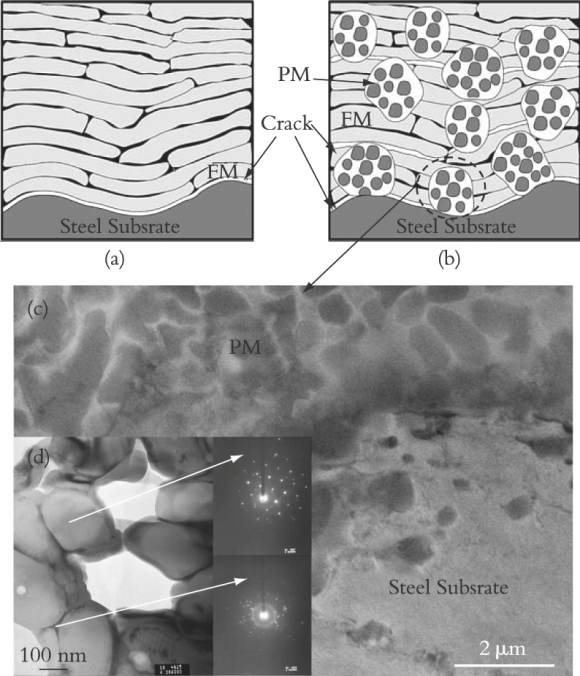
图1 传统结构涂层(a)、纳米结构涂层示意图(b),半融化区纳米结构放大图(c)[4,5]

Fig.1 Microstructure of coating deposited with nanopowder and micropowder

3 耐磨多层涂层失效机理及结构优化

高硬度涂层由于具有更好的耐磨性能,被广泛应用于工具和机械零部件上。然而,硬度和韧性并不能同时共存,Matthews[22]认为宏观力学下磨损行为主要决定于接触过程中的应力及应变分布和由此导致的弹塑性变形、磨屑的形成,而这往往取决于4个参数:涂层与基体的硬度、涂层的厚度、表面的粗糙度、接触界面间磨屑的硬度与尺寸。对于同一个接触面要获得低的磨损率,往往需要有较大的硬度、较高的剪切强度,显然同一种材料是达不到的。因此考虑从结构上提高涂层系统的韧性。多层涂层有更优于单层涂层或者双层涂层的性能,如耐磨损和耐腐蚀性能。更重要的是,多层涂层的引入增加了涂层单位厚度内的界面含量,可有效阻止裂纹的生成及扩展[23],这是由于多层涂层中裂纹极易被分支成多个裂纹,裂纹扩展在一定程度上受到抑制,从而减小了裂纹尖端的应力密度[24],提高其耐磨性。Zhang等[25]认为由于界面两边涂层弹性性能的差异,NiCrAl层能够阻碍裂纹的生长,具有更高的粘结强度和耐冲击性能。此外,Chan等[26]讨论了多层涂层中的裂纹生长以及应力分布,当裂纹遇到脆性层和韧性层的界面时,在界面上会发生塑性屈服,这会导致界面上的应力重新分布。Zhao等[27]证实了TiSiN涂层上沉积陶瓷涂层能够改善应力分布和减小应力水平,涂层/基体界面上的拉应力减小了50%。Subramanian等[28,29]认为通过调整涂层材料的组成,可以获得多层涂层,在设计过程中全面考虑多层涂层的结构设计[30],即通过结构优化来将涂层各自优异的摩擦学性能组合起来,调整晶粒尺寸和形状,由此来优化涂层的硬度、耐磨性等力学性能。因此,设计韧性材料与脆性材料交替分布形成的多层涂层是提高耐磨涂层抗法向载荷冲击、断裂韧性、粘结强度的主要方法。
不同的制备技术,不同的工艺参数都将影响涂层的结构和性能。Habig等[31]利用物理气相沉积(PVD)和化学气相沉积(CVD)制备了TiC、TiC/TiN、TiC/Al2O3和TiC/TiN/Al2O3等多层涂层,发现PVD沉积的 TiN比CVD沉积的TiC 具有更优异的力学性能。Derflinger[32]利用等离子体技术制备得到WC/C/TiAlN多层涂层,结果表明WC与TiAlN的界面间具有致密的结合。

4 耐磨复合涂层失效机理及结构优化

复合涂层是在原有涂层的基础上掺杂其他成分作为加强相,使涂层的结构更致密,性能更好,服役寿命更长。等离子喷涂制备ZrO2-SiO2复合涂层在ZrO2掺杂SiO2,经过激光熔覆后,涂层内裂纹明显减少[33]。掺杂Y2O3能阻碍高温下四方氧化锆的相转变,使得温度提高至1 200 ℃[34]。在Al2O3涂层中掺杂TiO2,涂层硬度、摩擦系数会降低,但是涂层的微观结构更致密。这是因为TiO2的熔点比Al2O3低,使得粉末的融化状态更好,TiO2的掺杂使得涂层的主要相变成了α-Al2O3γ-Al2O3以及Al2TiO5,提高了涂层的硬度和弹性模量[35]。然而,Yilmaz等[36]发现TiO2的掺杂使得涂层的硬度下降、断裂韧性增加。Zhao等[37]认为纳米结构Al2O3和微米结构Al2O3作为增强相的CuAl复合涂层具有更好的耐磨性。掺杂ZrO2相能提高铁基金属玻璃涂层的耐磨性能,但是随着ZrO2相的增加,涂层的韧性降低[38]。这说明制备工艺、复合涂层中第二相的加入对涂层的性能以及微观结构有很大的影响。
WC涂层能提高部件表面的耐磨、耐腐蚀性能,被广泛用于航空航天、冶金及能源领域。Elkhoshkhany 等[39]认为Ni-WC和Ni-Co-WC复合涂层的硬度随着WC的增加和晶粒尺寸的减小而增加,这是由于WC沉淀在晶界上阻碍了晶粒的长大。Deesom等[40]认为NiCr/CNTs 纳米复合涂层的孔隙率在0.4%~1%,NiCr/CVDCNTs复合涂层的硬度增加了20%。Sadri等[41]认为Ag作为自润滑相,能够降低涂层的摩擦系数,Ag的加入使得Cr2O3-Ag复合涂层的硬度降低,增加了复合涂层的断裂韧性。Du等[42]认为AgVO3的加入使得NiCoCrAlY-Cr2O3涂层的粘结强度从34.9 MPa增加到44.2 MPa,磨损率和摩擦系数明显减小。Cai等[43]认为Y2O3的加入大大降低了NiCrBSi-Y2O3复合涂层的磨损率及摩擦系数。Bolelli等[44]研究了NiCrAlY+Al2O3复合涂层的摩擦性能。在NiCrAlY中主要以粘着磨损为主,而在复合涂层中,Al2O3颗粒的剥落会导致小块摩擦层的形成。综上,第二相的加入能对涂层的性能造成显著的影响。

5 结 语

尽管涂层结构优化可以增加涂层的断裂韧性,获得较好的力学性能。但是由于涂层的脆性以及制备过程中产生的宏观缺陷的存在,增加了涂层的断裂韧性。因此,为深入理解涂层力学性能及失效机制,可以从以下几个方面展开深入研究:
(1)通过结构优化设计,如,控制送粉速率、送粉流量及喷涂距离等。分析不同应力状态下金属陶瓷过渡区的失效行为,研究梯度过渡区对涂层系统断裂韧性以及粘结强度的影响。
(2)进一步探索工艺参数-微观结构-力学性能之间的作用机理,制备无粘结层/陶瓷层界面涂层,利用材料计算技术模拟研究缺陷形成、裂纹扩展对涂层失效机制的影响,进一步理解涂层失效机理,为优化工艺参数提供理论依据。
(3)随着重熔研究和应用的不断深入,进一步对涂层进行表面重熔和热处理,优化重熔工艺参数,得到组织致密、质量优异的涂层[45,46],消除各熔滴间的界面和粘结层/基体界面,改善涂层的力学性能。
(4)利用双路送粉制备多层涂层,金属陶瓷过渡区取代粘结层与陶瓷层间的连续界面,若是能够消除粘结层与基体间的界面,将会进一步提高涂层的抗热震性能以及力学性能。裂纹在粘结层/基体的界面上的扩展机制也将会改变。
[1]
HAYNES J A, FERBER M K, RIGNEY E D , et al. Mechanical properties and fracture behavior of interfacial alumina scales on plasma sprayed thermal barrier coatings[J]. Materials at High Temperatures, 1999,16(2):49-69.

[2]
SZKODO M, BIEN A, ANTOSZKIEWICZ M . Effect of plasma sprayed and laser re-melted Al2O3 coatings on hardness and wear properties of stainess steel[J]. Ceramics International, 2016,42(9):11275-11285.

[3]
WANG Y, STEPHEN J, WANG M D , et al. Abrasive wear characteristics of plasma sprayed nanostructured alumina titania coatings[J]. Wear, 2000,237(2):176-185.

[4]
BANSAL P, PADTURE N P, VASILIEV A . Improved interfacial mechanical properties of Al2O3-13wt%TiO2 plasma-sprayed coatings derived from nanocrystalline powders[J]. Acta Materialia, 2003,51(10):2959-2970.

[5]
RODRIGUEZ J, RICO A, OTERO E , et al. Indentation properties of plasma sprayed Al2O3-13% TiO2 nanocoatings[J]. Acta Materialia, 2009,57(11):3148-3156.

[6]
倪立勇, 孙宏飞, 毕继鑫 . 等离子喷涂纳米陶瓷涂层的研究进展[J]. 材料保护, 2008,41(4):44-46.

[7]
邓世均 . 热喷涂高性能陶瓷涂层[J]. 材料保护, 1999,32(1):31-34.

[8]
刘英凯, 江斌, 辛俊峰 , 等. 等离子喷涂陶瓷涂层的现状与应用[J]. 山东陶瓷, 2009,32(1):19-22.

[9]
殷亚康, 孙耀宁 . 等离子喷涂陶瓷涂层的应用[J]. 电焊机, 2015,45(2):132-136.

[10]
隋育松, 徐可君, 江龙平 , 等. 陶瓷涂层在航空发动机涡轮叶片表面处理中的应用[J]. 材料保护, 2001,34(3):38-40.

[11]
GHADAMI F, SOHI M H, GHADAMI S . Effect of bond coat and post-heat treatment on the adhesion of air plasma sprayed WC-Co coatings[J]. Surface and Coatings Technology, 2015,261(15):289-294.

[12]
WANG L, LIU C G, ZHONG X H , et al. Investigation of crack propagation behavior of atmospheric plasma-sprayed thermal barrier coating under uniaxial tension using the acoustic emission technique[J]. ASM International, 2014,24(3):296-308.

[13]
ZHOU Y C, TONOMORIA T, YOSHIDA A , et al. Fracture characteristics of thermal barrier coatings after tensile and bending test[J]. Surface and Coatings Technology, 2002,157(2):118-127.

[14]
WANG Y, TIAN W, YANG Y , et al. Investigation of stress field and failure mode of plasma sprayed Al2O3-13%TiO2 coatings under thermal shock[J]. Materials Science and Engineering A, 2009,516(2):103-108.

[15]
YANG Y Y, MUNZ D, SCHALLER W . Effect of the stress jump at the interface of a joint on the failure behavior[J]. International journal of fracture, 1997,87(4):113-118.

[16]
ERDOGAN F . Fracture mechanics of functionaly graded materials[J]. Composites Engineering, 1995,5(7):753-770.

[17]
KHOR K A, DONG Z L, GU Y W . Effects of residual stress on the performance of plasma sprayed functionally graded ZrO2/NiCoCrAlY coatings[J]. Materials Science and Engineering A, 2000,277(1):64-76.

[18]
BAHR H A, BALKE H, FETT T , et al. Cracks in functionally graded materials[J]. Materials Science and Engineering, 2003,362(1):2-16.

[19]
DEMIRKIRAN A S, AVCI E . Evaluation of functionally gradient coatings produced by plasma-spray technique[J]. Surface and Coatings Technology, 1999,119(1):292-295.

[20]
LIANG B, DING C X . Thermal shock resistances of nanostructured and conventional zirconia coatings deposited by atmospheric plasma spraying[J]. Surface and Coatings Technology, 2005,197(2):185-192.

[21]
YANG Y, YAN D R, DONG Y C , et al. Preparing of nanostructured Al2O3-TiO2-ZrO2 composite powders and plasma spraying nanostructured composite coating[J]. Vacuum, 2013,96(10):39-45.

[22]
MATTHEWS A, LEYLAND A, HOLMBERG K , et al. Design aspects for advanced tribological surface coatings[J]. Surface and Coatings Technology, 1998,101(97):1-6.

[23]
RENJI Z . Studies on multilayer wear of CVD TiC-TiN multilayer composite coating[J]. Wear, 1991,147(2):227-251.

[24]
WIKLUND U, HEDENQVIST P, HOGMARK S . Multilayer cracking resistance in bending[J]. Surface and Coatings Technology, 2008,97(1):773-778.

[25]
ZHANG C, ZHOU H, LIU L . Laminar Fe-based amorphous composite coatings with enhanced bonding strength and impact resistance[J]. Acta Materialia, 2014,72(7):239-251.

[26]
CHAN K S, HE M Y, HUTCHINSON J W . Cracking and stress redistribution in ceramic layered composites[J]. Materials Science and Engineering, 1993,167(1):57-64.

[27]
ZHAO X L, XIE Z H, MUNROE P . Nanoindentation of hard multilayer coatings finite element modelling[J]. Materials Science and Engineering A, 2011,528(3):1111-1116.

[28]
SUBRAMANIAN C, Strafford K N . Review of multicomponent multilayer coatings for tribological applications[J]. Wear, 1993,165(1):85-95.

[29]
SUBRAMANIAN C, Strafford K N . Towards optimization in the selection of surface coating and treatments to control wear in metal-forming dies and tools[J]. Materials and Design, 1993,14(5):291-298.

[30]
HOLLECK H . Multilayer PVD coatings for wear protection[J]. Surface and Coatings Technology, 1995,76(1):328-336.

[31]
HABIG K H . Chemical vapor deposition and physical vapor deposition coatings:properties, tribological behavior and applications[J]. Journal of Vacuum Science and Technology A, 1986,4(6):2832-2843.

[32]
DERFLINGER V . New hard/lubricant coatings for dry maching[J]. Surface and Coatings Technology, 1999,113(3):286-292.

[33]
江志强, 席守谋 . 激光表面重熔等离子喷涂陶瓷涂层的研究和发展[J]. 材料工程, 1999,7(1):46-48.

[34]
PASCUAL C, DURAN P . Subsolidus phase equilibria and ordering in the system ZrO2-Y2O3[J]. Journal of the American Ceramic Society, 1982,66(1):23-25.

[35]
BANNIER E, VICENT M, RAYON E , et al. Effect of TiO2 addition on the microstructure and nanomechanical properties of Al2O3 suspension plasma sprayed coatings[J]. Applied Surface Science, 2014,316(15):141-146.

[36]
YILMAZ R, KURT A O, DEMIR A , et al. Effects of TiO2 on the mechanical properties of the Al2O3-TiO2 plasma sprayed coating[J]. Journal of the European Ceramic Society, 2007,27(3):1319-1323.

[37]
ZHAO X Q, AN Y L, HOU G L , et al. Preparation and tribological properties of plasma sprayed Nano and micro-structure alumina-reinforced CuAl composite coatings[J]. Tribology International, 2016,101(1):255-263.

[38]
CHU Z H, YANG Y, CHEN X G , et al. Characterization and tribology performance of Fe-based metallic glassy composite coating fabricated by gas multiple-tunnel plasma spraying[J]. Surface and Coatings Technology, 2016,292(25):44-48.

[39]
ELKHOSHKHANY N, HAFNWAY A, ALAA K . Electrodeposition and corrosion behavior of nano-structured Ni-WC and Ni-Co-WC composite coating[J]. Journal of Alloys and Compounds, 2017,695(25):1505-1514.

[40]
DEESOM D, CHAROENRUT K, MOONNNGAM S , et al. Fabrication and properties of NiCr/CNTs nanocomposite coatings prepared by high velocity oxy-fuel spraying[J]. Surface and Coatings Technology, 2016,306(25):323-327.

[41]
SADRI E, ASHRAFIZADEH F . Structural characterization and mechanical properties of plasma sprayed nanostructured Cr2O3-Ag composite coatings[J]. Surface and Coatings Technology, 2013,236(2):91-101.

[42]
DU L Z, ZHANG W T, ZHANG W G , et al. Tribological and oxidation behaviors of the plasma sprayed NiCoCrAlY-Cr2O3-AgVO3 coating[J]. Surface and Coatings Technology, 2016,298(25):7-14.

[43]
CAI B, TAN Y F, JING Q F , et al. Tribological behavior and mechanism of NiCrBSi-Y2O3composite coatings[J]. Transactions of Nonferrous Metals Society of China, 2013,23(7):2002-2010.

[44]
BOLEII G, CANDELI A, LUSVARGHI L , et al. Tribology of NiCrAlY+Al2O3 composite coatings by plasma spraying with hybrid feeding of dry powder+suspension[J]. Wear, 2015,344(15):69-85.

[45]
BUTA S S, PURI D, PRAKASH S , et al. Mechanical and metallurgical properties of plasma sprayed and laser re-melted Ni-20Cr and Stellite-6 coatings[J]. Journal of Materials Processing Technology, 2005,159(3):347-355.

[46]
CHEN C Z, WANG D, BAO Q H , et al. Influence of laser re-melted on the microstructure and phases constitution of plasma sprayed hydroxyapatite coatings[J]. Applied Surface Science, 2005,250(1):98-103.

Outlines

/