


采用原位乳液聚合法在基树脂中制备纳米PANI粒子,不仅可以使纳米PANI粒子保持乳液聚合的链结构规整性好、结晶度高、粒径均匀的优势[4,5],而且可以利用基料树脂的包裹作用,阻止纳米PANI的团聚。Jeon等[6]利用原位乳液聚合法制备出了PANI-PC(聚苯胺-聚碳酸酯)导电聚合物复合材料,分析表明PANI与PC之间存在着氢键作用,使得PANI的导电能力和拉伸强度增加,同时PANI的存在也使得PC的玻璃化转变温度升高。Chang等[7]用十二烷基苯磺酸作为表面活性剂、过硫酸钾作为引发剂,采用原位乳液聚合的方法制备出了PANI-MMT(聚苯胺-蒙脱土)纳米复合材料。Xie等[8]利用原位乳液聚合的方法,制备出了PANI-SBS(聚苯胺-苯乙烯系嵌段共聚物)复合材料,当PANI含量低于12%时,复合物具有较高的弹性和较低的永久形变。目前由于导电聚苯胺的力学性能、加工性能和环境稳定性能的影响,使其应用受到了限制。
本文将导电聚苯胺与高分子聚合物材料相复合,制备了一种纳米PANI-DBSA/EA/PU互穿网络导电复合膜,既具聚合物特征,又兼备导电性能;并对反应体系组成对复合膜导电和力学性能的影响进行了讨论,为PANI导电复合膜的实用化进一步奠定了基础。
1 实验部分
1.1 原料
蓖麻油(CO)、环氧丙烯酸树脂(EA):工业级,无锡树脂厂;苯胺、二月桂酸二丁基锡(DBTL):分析纯,天津市博迪化工有限公司;过硫酸铵:分析纯,天津市凯通化学试剂有限公司;十二烷基苯磺酸(DBSA):工业级,上海峰威化工有限公司;过氧化苯甲酰(BPO):分析纯,上海时代生物科技有限公司;二甲苯:分析纯,武汉华飞试剂厂;2,4-甲苯二异氰酸酯(TDI)、苯乙烯(St):分析纯,天津市富宇精细化工有限公司;γ-氨丙基三乙氧基硅烷(KH-550)、γ-缩水甘油醚氧丙基三甲氧基硅烷(KH-560):工业级,南京创世化工有限公司。
1.2 纳米PANI-DBSA/EA混合物的制备
取9 g DBSA和水置于三口烧瓶中,加入4 g二甲苯和16 g EA的混合溶液,搅拌均匀后加入苯胺单体,再将过硫酸铵的水溶液逐步滴加到体系中,控制过硫酸铵和苯胺的物质的量比为1∶1.2,待体系由乳白逐渐转变为蓝色,继续搅拌,冰水浴反应6 h后停止,得到墨绿色纳米PANI-DBSA/EA混合物。用蒸馏水洗涤,抽滤,恒温(60 ℃)真空干燥至恒质量。
1.3 PU预聚体的合成
将三口烧瓶置于冰水浴中,装上干燥回流管,加入50 g TDI和21 g二甲苯,再滴加91 g蓖麻油,快速搅拌反应2 h后停止,即可得到PU预聚体,在低温下密封保存。
1.4 纳米PANI-DBSA/EA/PU互穿网络导电膜的制备
取2.0 g纳米PANI-EA/EA共混物和6.0 g PU预聚体,并加入60%(以PU预聚体质量计,下同)的苯乙烯、0.4%的BPO、3%的KH-550及0.2%的DBTL,快速搅拌混合均匀,待混合物中气泡基本消失后,倾倒在干燥玻璃板上,置于烘箱中40 ℃固化7 d得到PANI-DBSA/EA/PU互穿网络导电膜。
1.5 性能测试
1.5.1 电阻率和电导率的测定
把复合膜切成1 cm×1 cm的正方形,用电子数显卡尺测定膜的厚度,用兆欧计(上海仪表厂)测定复合膜的电阻,其电阻率和电导率按式(1)和式(2)计算。
式中:ρ—电阻率,Ω·m;σ—电导率,S/m;R—试样电阻,Ω;D—试样厚度,m;S—试样面积,m2。
1.5.2 力学性能的测定
按GB/T 1040.1—1992用切刀将样品切成哑铃状,每组样品取8个样条,厚度约为0.6 mm,拉伸速度50 mm/min。用RGD-5型电子拉力机(深圳市瑞格尔仪器有限公司)测试复合膜的力学性能。
2 结果与讨论
2.1 纳米PANI-DBSA粒子含量对复合膜性能的影响
首先,在实验过程中加入占预聚体质量40%的St、0.5%的BPO,考察了纳米PANI-DBSA粒子的质量分数分别为1%、3%、5%、7.5%、10%、12.5%、15%时,对复合膜性能的影响,结果见图1。
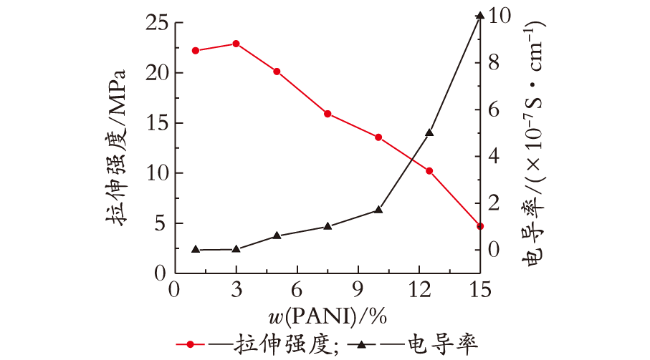
由图1可知,随着纳米PANI-DBSA含量的增大,复合膜的电导率逐步增大;当含量低于10%时,导电率与纳米PANI-DBSA含量基本呈线性关系;含量高于10%后,电导率急剧增大,在含量为15%时复合膜的电导率达10×10-7 S/m,并还有增大的趋势。复合膜导电是因为PANI-DBSA粒子相互接触形成导电通路,在体系中导电粒子含量较少时,导电粒子的填充量没有达到渗流临界值,复合膜中导电通路形成不完全,载流子的流动受阻,所以电导率较小[9,10]。随着纳米PANI-DBSA导电粒子增多,导电物质接触更充分,形成了导电网络,使载流子在导电通道中的流动更畅通,但纳米PANI-DBSA颗粒含量过多会导致复合膜的强度太低。
综合考虑,实验选择PANI-DBSA含量为12.5%,此时复合膜的拉伸强度为10.21 MPa,此时电导率是5×10⁻⁷ S/m。
2.2 交联剂用量及种类对复合膜性能的影响
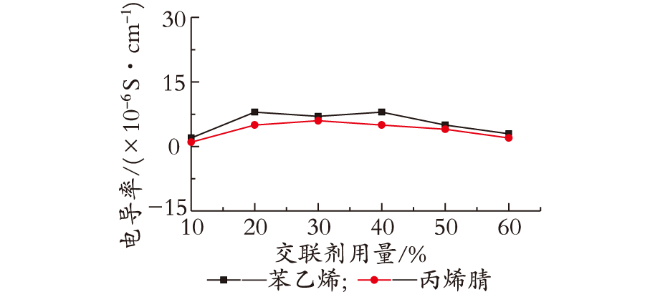
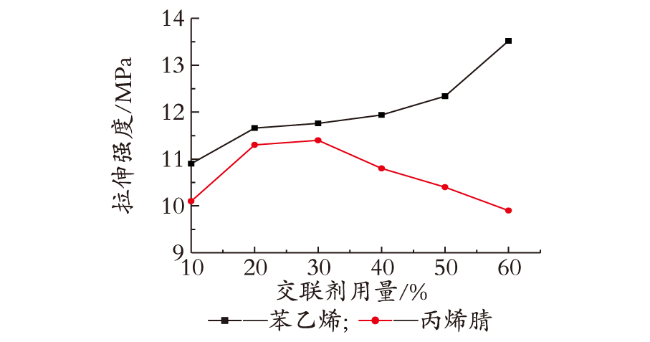
由图2、图3分别可知,交联剂的用量对复合膜导电性能的影响不大,而对复合膜力学性能的影响却完全不同。增加苯乙烯的用量,复合膜的拉伸强度逐渐增大,从10.9 MPa增加到13.5 MPa;而增加丙烯腈的用量,复合膜的拉伸强度先增加后减小,在用量为30%时达到最大值,为11.4 MPa。因为纳米PANI-DBSA/EA/PU互穿网络复合膜是由聚氨酯网络和聚烯烃网络相互贯穿形成的;聚烯烃网络是在自由基引发剂的作用下,体系中蓖麻油上的双键与交联剂中的双键发生自由基聚合反应形成的,苯乙烯中含有苯环,形成聚烯烃网络的强度比不含苯环的丙烯腈要大一些,同时苯乙烯中的苯环与PANI中的苯环具有很好的相容性,所以复合膜的强度逐渐增大。
综上分析,当选择苯乙烯为交联剂,且用量为60%时,复合膜拉伸强度最佳,为13.5 MPa,此时电导率为2×10⁻⁶ S/m。
2.3 偶联剂用量及种类对复合膜性能的影响
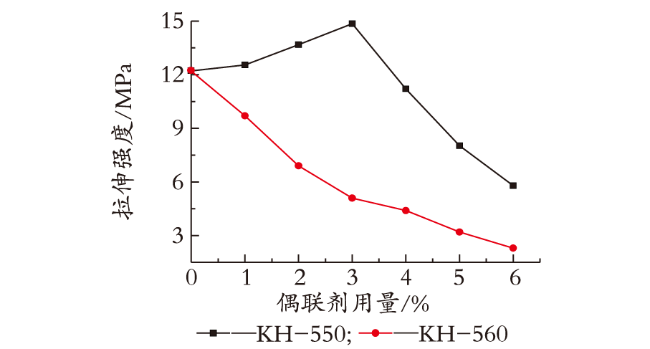
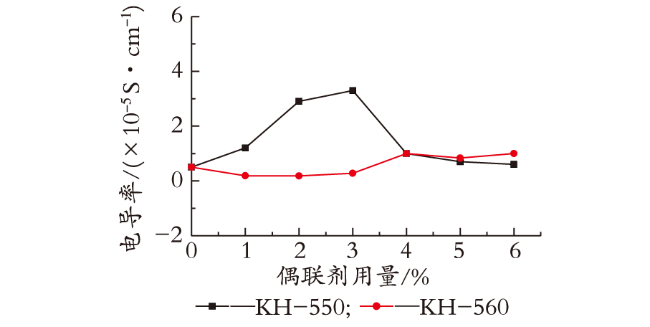
由图5中可知,2种偶联剂对复合膜导电性能的影响也是不同的。随着KH-550用量的增大,复合膜的导电率先增大后减小,在用量为3%时导电率出现最大值,比不加偶联剂时(5×10⁻⁶ S/m)增大了约1个数量级;而KH-560用量的增加对复合膜的导电性能影响不大。这是因为偶联剂KH-550改性后,PANI起到了一定交联点的作用,使导电通路形成更完全,所以导电率增大。
综上所述,当选择KH-550为偶联剂,且用量为3%时,复合膜的导电率和拉伸强度都达到最佳值,导电率为3×10⁻⁵ S/m,复合膜的拉伸强度为14.9 MPa,经偶联剂KH-550处理后的复合膜,导电率和拉伸强度都有提高。
2.4 引发剂用量对复合膜性能的影响
实验设定PANI-DBSA质量分数为12.5%,加入占预聚体质量60%的St、3%的KH-550、0.3%的DBTL,考察引发剂BPO用量(0.05%、0.2%、0.3%、0.4%、0.6%、0.8%,均以预聚体的质量计)对复合膜性能的影响,结果见图6。
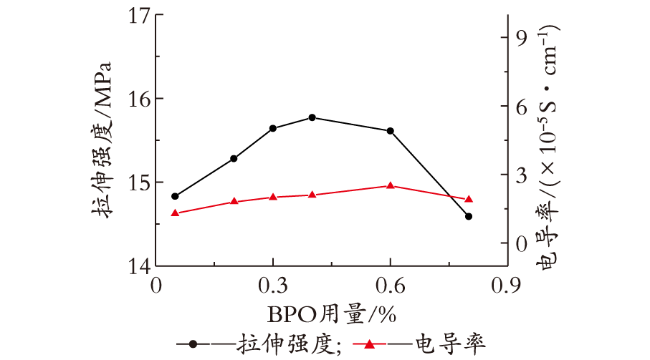


由图6可知,随着引发剂用量的增加,复合膜的拉伸强度先增大后减小,而导电率变化不大,在BPO用量为0.4%时拉伸强度达到最大值15.8 MPa,电导率为2×10⁻⁵ S/m。复合膜的导电性能主要与导电粒子数量有关,增加引发剂用量对纳米PANI-DBSA的数量没有影响,所以复合膜的导电率变化不大。复合膜力学性能主要与互穿网络聚合物的强度及互穿网络聚合与纳米PANI-DBSA粒子的相互作用有关,BPO是一种自由基引发剂,其用量对互穿网络中聚烯烃网络的形成有较大的影响。增加BPO的用量,反应体系中产生的自由基数量增加,聚合速率增加,有利于聚烯烃网络的形成。但是BPO过量,体系中会产生过多的反应中心,使生成的聚合物相对分子质量减小,聚烯烃分子链变短,互穿网络的强度下降。
3 结 语
(1)采用原位乳液聚合法在环氧丙烯酸树脂(EA)中合成了纳米聚苯胺(PNAI-DBSA),将纳米PNAI-DBSA/EA共混物与蓖麻油聚氨酯(PU)预聚体、交联剂聚合,在引发剂BPO的作用下生成了PANI-DBSA/EA/PU互穿网络导电膜,复合膜的电导率随着纳米PANI-DBSA含量的增加而增大。
(2)在PANI-DBSA质量分数为12.5%;苯乙烯用量占预聚体质量60%时,BPO用量为0.4%,偶联剂KH-550用量为3%时,复合膜的电学和力学性能最好,电导率为2×10⁻⁵ S/m,拉伸强度达到15.8 MPa。经偶联剂KH-550处理后的纳米PANI-DBSA在PU预聚体中分散性得到了有效改善,从而提高了复合膜的导电率和拉伸强度。